Understanding tariffs and trade in the age of globalization
People are searching for “tariff” more than ever. What tariffs are, where the rules of world trade came from, and why it matters for your wallet.
Read aloud by your device's built-in voice.
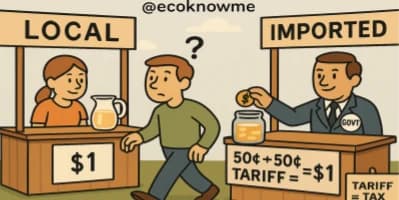
What is a tariff?
Lately, people have been searching for “tariff” more than ever, according to Google Trends. This interest seems tied to talk about new trade policies, like those proposed by Donald Trump, who suggested tariffs to boost the U.S. economy. But what exactly are tariffs, and why do they matter so much now?
Long ago, countries didn't trade much because they couldn't easily connect. Over time, trade grew, letting countries share resources and ideas. Today, trade involves imports (buying from abroad) and exports (selling to other countries).
Companies often move production to countries with cheaper labor, a process called offshoring, to cut costs. For example, making a phone in a country with lower wages can mean a cheaper phone for you. Sounds good, right? But this can also lead to job losses at home, and sometimes a trade deficit, where a country buys more than it sells. While trade deficits aren't always bad, they can affect the health of your country's economy if they grow too large.
As trade rapidly expanded from neighboring countries to distant continents, world leaders recognized the need for laws and regulations to govern global commerce, giving rise to what we now know as globalization.
From GATT to the WTO
It started with GATT (the General Agreement on Tariffs and Trade) in 1947, a multilateral agreement to reduce tariffs and other trade barriers after World War II and prevent future economic conflicts. It was replaced by the WTO (World Trade Organization) in 1995, a global institution, not just an agreement.
| Feature | GATT (1947–1994) | WTO (1995–present) |
|---|---|---|
| Type | Legal agreement | International organization |
| Scope | Goods only | Goods, services, intellectual property (TRIPS) |
| Disputes | Weak enforcement | Binding dispute settlement system |
| Members | 123 by 1994 | 164+ (as of 2025) |
| Updates | Periodic rounds | Continuous negotiation and monitoring |
Is the return of trade wars a failure of globalization itself, or a failure of the United States to manage globalization in a way that serves its citizens?
This series of articles examines whether the current resurgence of trade conflicts, particularly the United States' engagement in trade wars, reflects a broader failure of globalization itself, or rather a failure on the part of the United States to manage globalization in a manner that advances the interests of its citizens.
Sources

Analiz is written by the Ecoknowme team: tax, finance and economics, explained for Haitian, Francophone and immigrant families in three languages.